

Solana vs Ethereum: Why Meme Token Hunters Flock to Solana
The Great Migration: Meme Coin Hunters Abandoning Ship
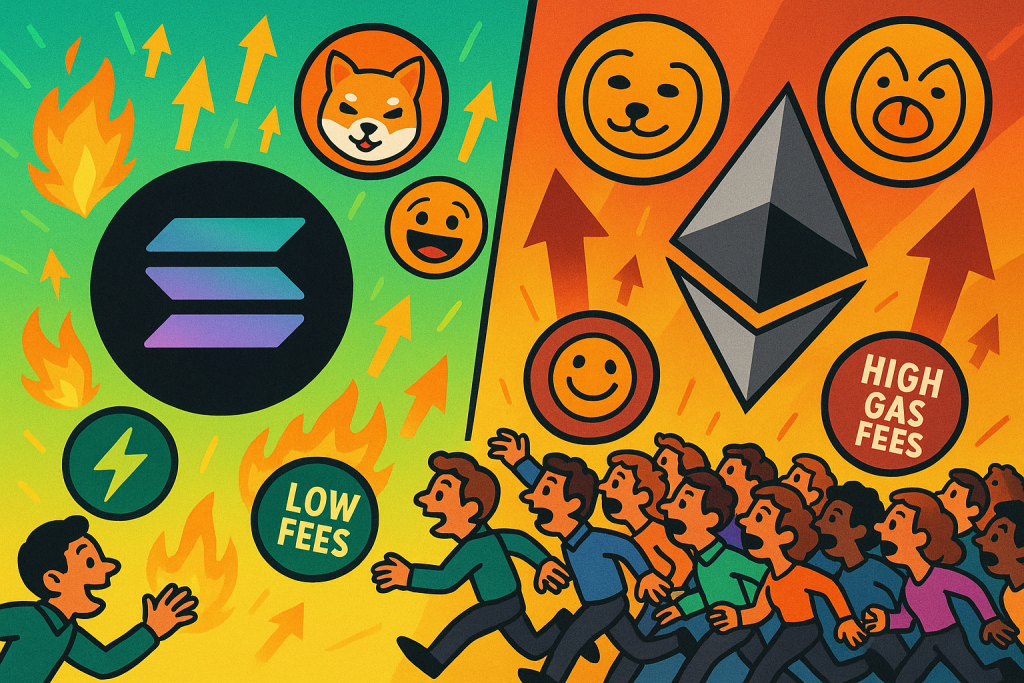
Meme coins – those wonderfully chaotic, community-driven tokens that can turn pizza money into Lambos (or Lambos into pizza money) – are experiencing a fundamental shift in their homeland. For years, Ethereum was the undisputed king of meme tokens. It’s where DOGE and SHIB built their empires, where countless animal-themed coins rose and fell, and where the very concept of a “meme token” was practically born. But now Solana meme tokens vs Ethereum gas fees is a real debate to be had.
But that’s just it – times are changing. And if you’ve been paying attention to the explosive growth in the meme coin sector lately, you’ve probably noticed something: Solana is stealing the show.
Don’t get me wrong, Ethereum still hosts plenty of meme coin action… but the energy, the innovation, and yes – the truly insane gains – they’re increasingly happening on Solana. According to recent on-chain data, meme token trading volumes on Solana have increased by over 300% in the past six months, while new meme token launches on Ethereum have seen a steady decline.
Let me explain why this shift matters, especially if you’re hunting for those elusive 100x gems in the wild world of meme tokens.
Gas Fees vs. Lightning Speeds: Solana Meme Tokens vs Ethereum Gas Fees
The old addage of Solana meme tokens vs Ethereum gas fees. Imagine you’ve done your research, found a promising new meme coin with a hilarious concept and growing community, and want to throw in $200 to see where it goes. Sounds simple enough, right?
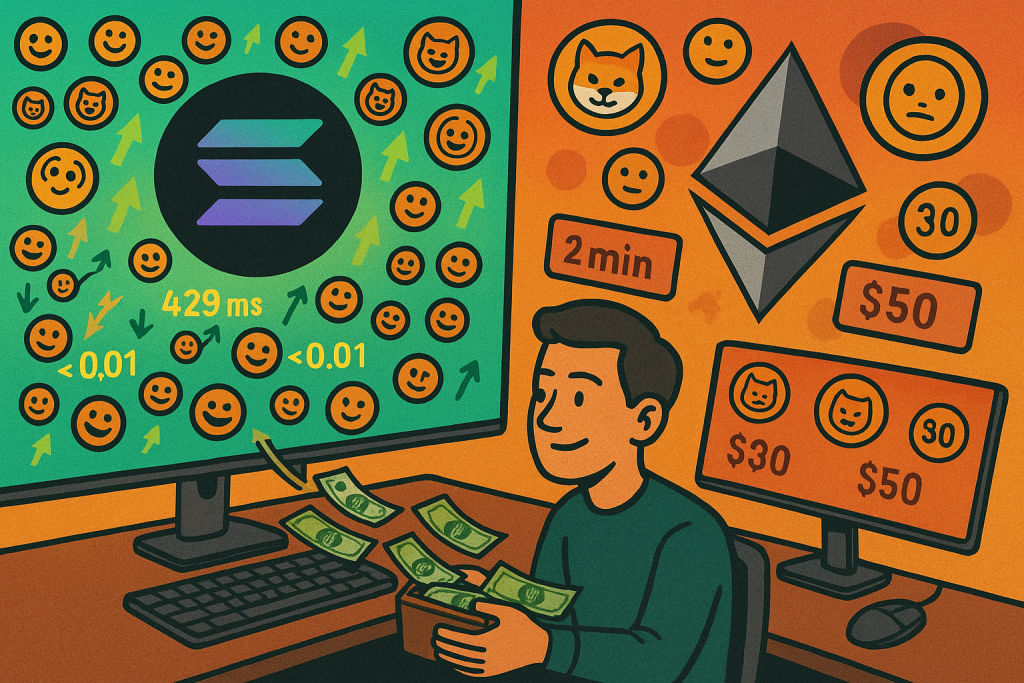
On Ethereum, that $200 investment might cost you another $30-80 just in gas fees to make the swap. And if the token pumps and you want to take profits? That’ll be another hefty fee, please. Want to split your capital across 10 different meme plays? Good luck getting anywhere with that strategy when transaction fees are eating half your investment budget.
The truth is, Ethereum’s gas fees have created a serious barrier to entry for smaller traders – precisely the demographic that drives much of the meme coin market. As one prominent meme token trader @SolanaWhale noted: “When I was trading exclusively on Ethereum, I needed at least $1000 to make any play worthwhile because of gas fees. On Solana, I can split that same $1000 across 20 different tokens and still keep most of my capital actually invested in the tokens.”
This economic reality has concrete implications for trading strategies. On Solana, you can:
- Make multiple small-cap plays with minimal overhead
- Take partial profits at different price points without fee concerns
- React quickly to market movements without worrying about transaction costs
- Test new projects with small amounts before committing more capital
The comparison is even more stark when we look at transaction speeds. Ethereum transactions typically take minutes to confirm (sometimes longer during network congestion), while Solana transactions are confirmed in seconds. When a meme coin is pumping or dumping, that time difference can determine whether you catch the wave or get left behind.

Community Vibes: The Culture Shaping Meme Token Success
Meme coins aren’t just about technology – they’re cultural phenomena driven by communities. And there’s a distinct difference between the Ethereum and Solana meme scenes.
Ethereum’s meme culture tends toward the established, the battle-tested, and sometimes, let’s be honest, the slightly jaded. It’s where the OGs play, where projects often need significant marketing budgets and influencer backing to gain traction, and where the bar for entry has gradually risen over the years.
Solana’s meme community? It has that familiar mix of awe and unease that comes with any gold rush. It’s more accessible, more experimental, and – for better or worse – more chaotic. The barrier to entry is lower, both for developers creating tokens and traders hunting for gems. This has created a vibrant ecosystem where creativity and community building often trump marketing budgets.
“The Solana meme community feels like Ethereum did back in 2020-2021,” explains crypto researcher Maria Chen of BlockResearch. “There’s an energy and excitement that attracts both creators and traders looking for the next big thing. When communities feel like they’re building something new together, that’s when meme magic happens.”
This cultural difference manifests in how meme projects develop and grow:
- Ethereum meme projects often follow established playbooks and marketing strategies
- Solana meme projects frequently experiment with novel tokenomics and community-building approaches
- Ethereum has more “establishment” backing and institutional eyes watching
- Solana has a more frontier-like atmosphere where retail traders have more influence
Neither culture is inherently better – they’re just different playing fields attracting different types of players.
The Hard Numbers: Transaction Costs That Make Traders Think Twice
It’s cool and all to talk about community vibes and cultural differences… but not that useful without concrete numbers to back it up. So let’s break down the actual cost differences that are driving this migration.
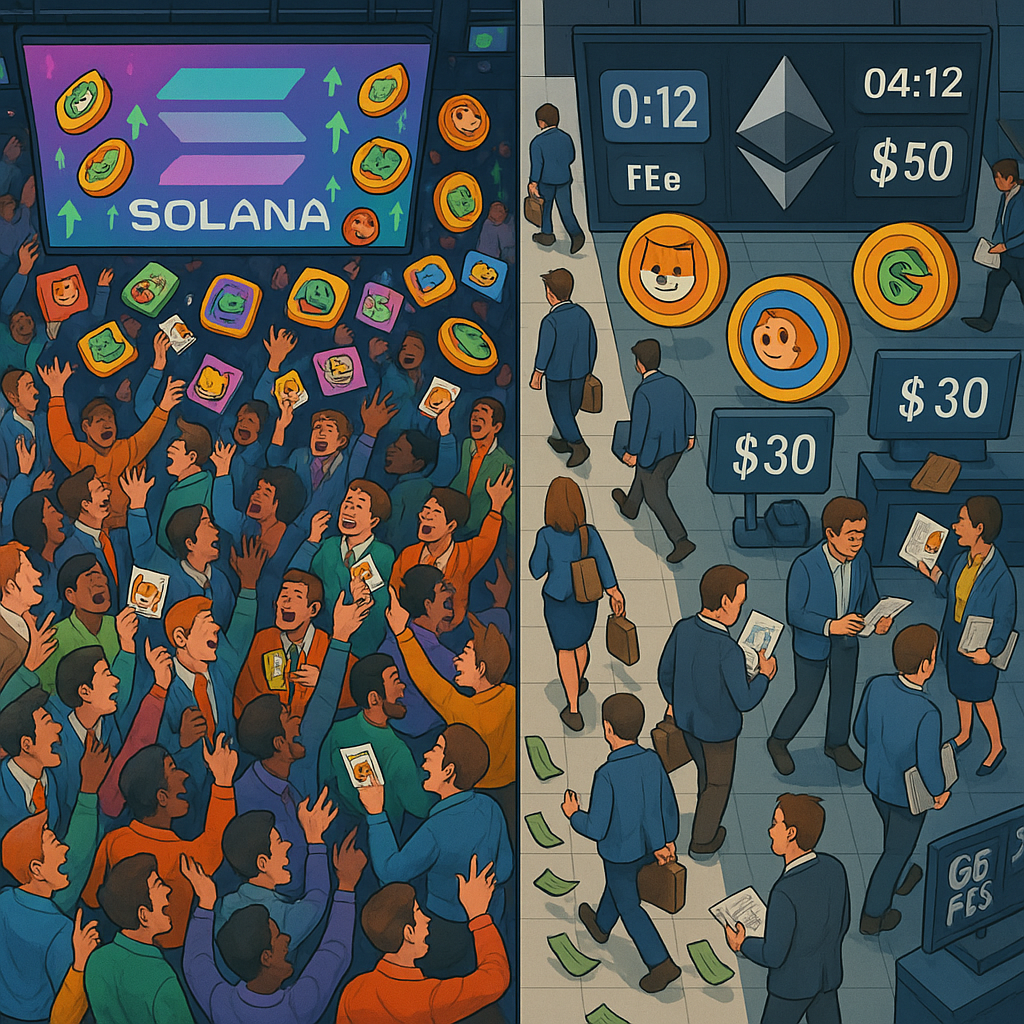
Based on average network conditions in early 2025, here’s what traders typically experience:
Ethereum:
- Average swap fee: $25-45 (during normal network conditions)
- Average transaction time: 1-3 minutes
- Peak congestion fees: Can exceed $100 per transaction
- Cost for approving a new token: $15-30
Solana:
- Average swap fee: $0.02-0.10
- Average transaction time: 400ms-2 seconds
- Peak congestion fees: Rarely exceeds $0.25
- Cost for approving a new token: N/A (not required on Solana)
For a trader making 50 transactions per month (entries, exits, and portfolio adjustments), the fee difference is staggering:
- Ethereum: Approximately $2,000+ in monthly fees
- Solana: Approximately $5 in monthly fees
According to blockchain analytics firm CryptoMetrics, “The average meme token trader on Solana makes 3.8x more transactions than their counterpart on Ethereum, yet pays 99.7% less in fees annually.”
This stark contrast explains why many traders, especially those with smaller portfolios, are migrating to Solana. When your total investment budget is $1,000-$5,000, losing a significant percentage to fees is simply not sustainable.
The Opportunity Landscape: Where Are the Gems?
But what about actual investment opportunities? Is one chain truly better than the other for finding those legendary 100x meme coin plays?
Let’s analyze the data. According to MemeTracker’s 2025 Q1 report, Solana meme coins showed these patterns:
- Higher frequency of 10x+ returns (8.3% of new projects vs 2.1% on Ethereum)
- Shorter time from launch to peak (average 12 days vs 38 days on Ethereum)
- Lower average market cap at launch ($250K vs $2.2M on Ethereum)
- Higher volatility in both directions
Meanwhile, Ethereum meme coins demonstrated:
- Higher average longevity (projects remaining active after 6 months)
- Larger average maximum market caps when successful
- More mainstream recognition and exchange listings
- Lower rug pull/abandonment rates (though still significant)
What this tells us is that Solana has become the preferred hunting ground for high-risk, high-reward plays and rapid trading, while Ethereum remains stronger for longer-term meme coin holds with more established communities.
“I keep my ‘blue chip’ meme positions on Ethereum and do my active hunting on Solana,” explains @CryptoGemFinder, a popular meme coin analyst with over 200,000 followers. “They serve different purposes in my strategy, and I think savvy traders understand it’s not an either/or proposition.”
Trading Psychology: The Hidden Factor in Chain Selection
There’s another aspect that doesn’t get discussed enough: how the technical differences between chains affect trading psychology and decision-making.
When transaction fees are high, as on Ethereum, traders tend to:
- Hold positions longer (sometimes too long)
- Be less reactive to market movements
- Make fewer but larger bets
- Experience greater FOMO when missing opportunities due to fee concerns
On Solana, the low-fee environment creates different psychological patterns:
- More willingness to take profits early
- Less attachment to positions
- More experimental trading with small caps
- Less hesitation to cut losses
This psychological difference can’t be overstated. Many traders find that Solana’s environment allows them to trade more closely aligned with their actual strategy rather than being influenced by fee considerations.
As behavioral finance researcher Dr. Amanda Johnson notes: “High transaction fees create decision friction that often leads to suboptimal trading choices. In our studies, we’ve found that traders on low-fee networks more consistently stick to their predetermined trading plans.”
Security Considerations: Not All Sunshine on Solana
Don’t get me wrong – Solana’s meme coin explosion isn’t without significant risks that every trader should understand.
The lower barrier to entry that makes Solana attractive for traders also makes it easier for developers to launch questionable projects. The ecosystem has seen its fair share of rug pulls, honeypots, and abandoned projects, often at a higher rate than Ethereum.
Additionally, Solana’s historical network outages – while increasingly rare – represent a risk factor that Ethereum traders don’t typically worry about. Nothing is worse than being unable to exit a position during market volatility because the network is experiencing issues.
Ethereum’s more mature ecosystem also provides certain security advantages:
- More established security tools and analytical resources
- Better contract auditing infrastructure
- Longer history of stress testing
- More developed recovery options for certain types of scams
As security researcher @BlockchainDefender puts it: “Solana is like the Wild West for meme coins – opportunities are everywhere, but so are the outlaws. Ethereum is more like a developed city with better security but higher costs of living.”
Finding Your Edge: Which Chain Fits Your Trading Style?
The truth is, there’s no one-size-fits-all answer to which blockchain is “better” for meme coin trading. It depends entirely on your:
- Capital Size: Smaller portfolios ($5K or less) typically benefit more from Solana’s low fees
- Trading Frequency: Active traders making multiple moves weekly will save significantly on Solana
- Risk Tolerance: Higher risk appetites often align better with Solana’s more volatile environment
- Technical Comfort: Newer users sometimes find Ethereum’s more established infrastructure easier to navigate
- Time Commitment: Solana requires more active monitoring due to faster market movements
Many successful traders are actually using both chains strategically:
- Using Solana for small-cap gem hunting and active trading
- Using Ethereum for longer-term holds of established meme projects
- Maintaining wallets on both chains to capitalize on cross-chain opportunities
- Using Ethereum during Solana network congestion and vice versa
“The most successful meme traders I know aren’t maximalists for either chain,” explains DeFi researcher Maya Williams. “They understand each ecosystem’s strengths and weaknesses and position themselves accordingly.”
The Evolution of Cross-Chain Trading
An interesting development in 2025 has been the growth of cross-chain meme token trading, where projects launch simultaneously on multiple chains or bridge quickly between them.
This trend has been facilitated by improved bridging solutions that make moving assets between Ethereum and Solana more seamless than ever before. According to ChainBridge Analytics, cross-chain meme projects have seen 140% higher average returns than single-chain launches in the past quarter.
Some strategies emerging in this cross-chain landscape include:
- “Bridge arbitrage” where traders exploit price differences between the same token on different chains
- “Multi-chain community building” where projects cultivate different community segments on each chain
- “Chain diversification” where traders spread risk across ecosystems
This evolution suggests that the future may not be about Solana versus Ethereum, but rather how traders can leverage both ecosystems effectively.
Making the Switch: Practical Considerations
If you’ve been primarily trading on Ethereum and are considering exploring Solana’s meme ecosystem, here are some practical considerations:
- Wallet Setup: Phantom and Solflare are the most popular and user-friendly Solana wallets
- Capital Transfer: Use established bridges like Wormhole or centralized exchanges for moving funds
- Exchange Differences: Get familiar with Jupiter Aggregator and Raydium, Solana’s primary DEXs
- Learning Curve: Expect different terminology and slightly different processes
- Community Resources: Join Solana-focused Discord servers and Twitter communities for intelligence
The learning curve isn’t particularly steep if you’re already comfortable with Ethereum, but there are differences that will take some adjustment. The most significant initial challenge is often just getting your capital onto the Solana ecosystem safely and efficiently.
Conclusion: The Shifting Landscape of Meme Token Trading
As we navigate through 2025, the trend of meme token activity shifting toward Solana shows no signs of slowing. It surely does come down to Solana meme tokens vs Ethereum gas fees. The economic reality of transaction fees, combined with Solana’s speed advantages and growing community, has created a compelling environment for traders seeking the next big meme coin opportunity.
However, Ethereum’s established infrastructure, security advantages, and blue-chip meme projects ensure it remains a crucial part of the meme token landscape. The most successful traders are those who recognize the unique advantages each chain offers and position themselves accordingly.
Whether you’re a seasoned meme coin hunter or just looking to dip your toes into this volatile but exciting corner of crypto, understanding the Ethereum-Solana dynamic is essential to developing an effective strategy. The chains aren’t just technical platforms – they’re ecosystems with their own cultures, economics, and opportunities.
The great meme coin migration to Solana isn’t about one chain “winning” – it’s about the natural evolution of a market finding efficiency and opportunity where it exists. Smart traders follow that efficiency, regardless of which logo is attached to it.
What’s your experience been with meme trading across these chains? Have you made the switch to Solana, stayed loyal to Ethereum, or found ways to leverage both? Whatever your approach, the meme coin landscape in 2025 offers more opportunities than ever before – if you know where to look.